Using RAII for open-close pair
Terms
- Action
- In this article, this term may mean programming actions, such as calling functions, modifying variable, writing to stream, or more.
- Open-close action
- Actions which requires pair of opening and closing actions. Read open[ing] action and clos[e | ing] action for more details.
- Open[ing] action
- Actions which clos[e | ing] action should be accompanied, when itself is successfully done. (ex. A file object failed to be opened doesn’t need to be closed, otherwise it should be closed.)
- Clos[e | ing] action
- Actions which should be followed, if matching open[ing] action is successfully done.
Background
Some programming actions must be accompanied with matching closing actions, in any case. Memory deallocation, closing file and socket connections, and unlocking mutex for concurrent programming are the examples. This can be accomplished by writing closing code in reverse order after required jobs are done.
// Opening.
auto const file = openFile("file_name.png");
auto const socket = openSocket("receiver.link.org");

// Do something with file and socket.
copy_file_to_socket(file, socket);

// Closing.
// Attention that closing actions should be done in
// reverse order of opening actions.
closeSocket(socket);
closeFile(file);
This code is usually come up with beginner programmers who do not care about code jump done by programming language. Though there are few programming languages which do not allow any kinds of code jump, most of modern ones provide code jump or alternatives. Features listed below can cause explicit or implicit code jumps.
Code jump
Literally, code jump can cause code jump, which can cause omitting closing code. The example below shows how code jump can cause disaster.
auto const file = openFile("file_name.png");
auto const socket = openSocket("receiver.link.org");

does();
something();
if ( condition() )
{
        // Used go-to instead, since c++ does not support jump.
        // If this is called, closing code will be ignored.
        goto asdf;
}

closeSocket(socket);
closeFile(file);

asdf:
Exception handling
Exception handling feature let a program flow can be jumped to somewhere else when exception is occured, so that code depends on prior code is not excuted. Of course, those ignored code may contain closing actions.
Function return
When a function meets its end, the function is returned automatically.
However, it can be done by using return keyword explicitly as well.
If this keyword is used before closing actions are done, the code has
potential of missing closing actions.
Break and continue
Break and continue features are used in a loop statement such as for or
while. Break ignores extra code in the loop and quit cycling, and
continue does similar jobs except that continue invokes the loop again.
Program termination
Sometimes a program is terminated without returning of its main function, which is usually unexpected behavior or caused from a programmer’s mistake. This case is ignorable, since it’s usually not happen in ordinary circumstances, and even RAII cannot handle this problem.
To solve this problem, many programming languages adopted try-catch-finally statement, which enforces code in finally part is run in any case, when a program flow trying to escape from the try-catch scope. This feature let the problem can be solved in elegant way, while it still missing few desired features.
try-catch-finally statement does not force closing actions
to be done in reverse order
of opening actions, nor force closing code should be used. This
expression does not produce any of compile error even if we write
openFile() and omit closeFile().
Some programming languages do not provide exception handling and try-catch staement. Few languages only support try-catch for exception handling, but not finally. To solve this problem without finally statement, RAII can be used.
Introduction
RAII, which is abbreviation of Resource Acquisition Is Initialization, is a technique uses constructor and destructor.
Using of RAII brings a lot of advantages than using raw code or using finally statement. By using a class which contains opening code in constructor and closing code in destructor, programmers could have guaranteed that closing code must be called if opening code is successfully called. If opening code fails, closing code will not be called as well. Destruction is done in reverse order of construction, so order of closing actions are guaranteed as well.
struct File
{
        // Start of OAP
        File(char const* path)
        {
                fileId = openFile(path);
                this->path = path;
        }
        char const* const path;
        // End of OAP

        // Start of CAP
        ~File()
        {
                closeFile(fileId);
        }
        int fileId;
        // End of CAP
};
struct Socket
{
        // Start of OAP
        Socket(char const* path)
        {
                socketId = openSocket(path);
                this->path = path;
        }
        char const* const path;
        // End of OAP

        // Start of CAP
        ~Socket()
        {
                closeSocket(socketId);
        }
        int socketId;
        // End of CAP
};
int main()
{
        File file("file_name.png");
        Socket sock("receive.link.org");

        copy_file_to_socket(&file, &socket);

        return 0;
}
This is a RAII version of the example at the beginning. Opening code is
replaced into object construction, and closing code is removed, since
destructor will be called automatically if the program goes out of
main() function scope.
Details
By dividing RAII idiom, there are Opening Action part(OAP) and Closing Action part(CAP). OAP contains constructor and variables used in opening. CAP contains destructor and variables used in closing. Variables used in opening and closing can be shared: it means a variable can be both OAP and CAP. Both parts may have no variable, if they do not need them. For instance, mutex lock does not require any of OAP variable, not like open file, which requires file name or path.
Mutation: Post-openable and pre-closable RAII(POPC-RAII)
RAII doesn’t need to do opening action in constructor and closing action in destructor. RAII can be implemented so that opening actions can be done after RAII’s constructor is called and closing actions can be done before destructor is called. If it’s closed, it can be re-opened as well. Of course, this comes with a little bit more cost, more code and more performance loss.
This mutation introduces one more part, Status Checking part(SCP). SCP includes functions and variables used to check whether the RAII instance should do closing actions or not.
struct File
{
        // Start of OAP.
        File() // Constructor does not call opening code.
        {
        }
        File(char const* path) // Constructor calls opening code.
        {
                open(path);
        }
        void open(char const* path)
        {
                this->path = path;
                id = openFile(path);
        }
        char const* path;
        // End of OAP.

        // Start of CAP.
        ~File()
        {
                close();
        }
        // Safe-version of forceClose().
        void close()
        {
                if ( isOpened() )
                {
                        forceClose();
                }
        }
        void forceClose()
        {
                closeFile(id);
        }
        int id  = 0; // Both CAP and SCP.
        // End of CAP.

        // Start of SCP
        bool isOpened() const
        {
                return id != 0;
        }
        void ignore()
        {
                id = 0;
        }
        // End of SCP

        File(File const& another)
        {
                if ( another.isOpened() )
                {
                        path = another.path;
                        id = another.id;

                        another.ignore();
                }
        }
        File& operator =(File const& another)
        {
                close();

                if ( another.isOpened() )
                {
                        path = another.path;
                        id = another.id;

                        another.ignore();
                }
        }
};
This is implementation of POPC-RAII. New part SCP is introduced, and move constructor and operator are implemented. Below describes difference between primeval RAII and POPC-RAII.
Constructor and destructor do not represent opening code and closing code,
instead code are separated into open(), close() and forceClose()
functions. Constructor simply determines that the user want to run opening
actions right away(if constructor has parameter) and calls open() if it
is. Destructor calls close() to call closing actions safely, since
opening actions could be not performed or closing actions could be already
proceeded. close() calls forceClose() only if isOpened() returns
true.
id variable, which is descriptor id of file, has 2 usages. First it can be
used as key when performing closing actions, and second, determines whether
the file is opened or not. 0 value of id means closed file, otherwise it means
opened file. isOpened() returns true if id is not 0, otherwise returns
false. This is the reason why id is both CAP and SCP. This kinds of
pattern can be used in many places, since many libraries left negative,
null or 0 value to represent null and invalid state. For example, null pointer
of an object can represent that the object is not constructed.
POPC-RAII can be moved, which is the new feature first-introduced in C++11. Primeval RAII cannot be moved, since destructor will call closing code without any exception, and moving it will be end up with proceeding closing actions twice or more. Since POPC-RAII can be closed during its lifetime, moving is not non-sense.
There are 2 concepts, source and target. They means as what their names say. In below code, A is source and B is target.
B = A;
When move-constructor is called, the target should have no file id. If the
source is valid, data should be moved and ignore() of source must be
called, to represent the source is not valid any more.
ignore() simply let the RAII is not responsible to run closing actions.
It should make the RAII’s isOpened() returns false without closing.
Implementing
move-operator need to have one more step, calling close() before do move
operation, since it may have previous opened file.
Rule of One-Entry
RAII can be used in various situations, and sometimes destructing RAII or
calling something like close() is not the only option to run closing
actions.
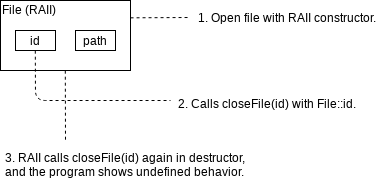
The case above can happen if how a RAII class is not properly documented.
Hiding File::id is one option, but sometimes the variable must be used
for other purposes which is not closing.
The most safe way to handle this is making RAII as the only way to do closing actions, and this is the only-option for primeval RAII. Also this is the cleanest way, and the most straight-forwarding way.
If POPC-RAII is used, making closing function like following one can be another solution.
void closeFile(File* raii)
{
        closeFile(raii->id);
        raii->ignore(); // Release responsibility of calling closing actions.
}
But still the function requires pointer of RAII instance.